Monday, 30 November 2009
Media Workshop - Preliminary task
In the workshop we learnt how to use different camera shots and how to cut the scene so that they appear to run smoothly and we also learnt how to edit all the video content with Adobe Premiere Elements 4.0 after we had filed all of the scenes. We also learnt all the small things that go into the filming of the scene such as; how to use and connect the microphone into the camera and what the 90 degree and 120 degree settings are on the microphone do and how to setup the tripod properly and accurately to reduce the camera shaking. We also learnt how to plan filming a scene using a storyboard, to help us plan what camera angles and shots we were going to use in the preliminary task. So we had to learn all of the different types of camera shots and angles and what mood they can create, for example a close up or an extreme close up of a characters face can show their emotion in much more detail and is a good way to show a reaction shot.
Overall I thought that the film was okay. I do feel that we could have improved on it if we had more than a day to work on it. Firstly I would have added some music or sound effects to the scenes to make them more suspensful and I also would have added text and titles. I also feel that some of the cuts have bad continuity, particularly the part where the character opens the door and when the camera is looking over his shoulder there is a chair next to the table and when he gets to the table the chair has gone. The last improvement that I would have made would be to make some of the cuts of the scenes a lot smoother instead of it seeming to jump from one place to another.

Friday, 20 November 2009
Film openings
Apocalypse Now
Apocalypse Now starts with the sound of a helicopter, the screen the fades in and there is a tropical forest. Then the helicopter drifts in and out of shot and music starts and explosions of napalm fill the forest. The helicopter blades then turn into a ceiling fan and Martin Sheen's face fills the left side of the screen. The Diagetic sounds within the film after the opening give a surreal feel, like he is still in a dream. The part where his head is upsidedown and on one side of the screen while the images of war and destruction are on the other half of the screen gives a feel that he is always thinking of war and it's always on his mind.
Blade Runner
Blade runner opens with a cityscape. It is dark and there are bursts of fire coming from some of the buildings. The camera then cut to a close up of a pupil with the reflection of the cityscape in it. The camera then slowly zooms throught city, with flying cars whizzing past, and finally come to a building where it looks through the window and the first scene begins. The emphasis on eyes in the opening scenes show that the film has a stron theme of eyes within the theme, however, you have to watch on to find out why. The titles before the cityscape appears are slow, simple and ordinary, which creates tension within the audience.
28 Days Later
The opening scene with the escaping monkey's creates lots of enigmas, these include; what is rage? Why is the doctor scared? Why are these monkeys in captivity? Why are the monkeys being forced to watch violent activity? This first scene also creates panic and tension within the audience, this is done by using loud noises, quick cuts and a shaking camera style.
The scene then changes to a man in a hospital and the mood is very calm as there is no sound what so ever, however there are more enigmas in the audiences mind, where has everyone gone? Why is he the only person that seems to be there? All of these techniques that have been used attract the audience's attention from the start and make them want to keep watching so there questions are answered.
Apocalypse Now starts with the sound of a helicopter, the screen the fades in and there is a tropical forest. Then the helicopter drifts in and out of shot and music starts and explosions of napalm fill the forest. The helicopter blades then turn into a ceiling fan and Martin Sheen's face fills the left side of the screen. The Diagetic sounds within the film after the opening give a surreal feel, like he is still in a dream. The part where his head is upsidedown and on one side of the screen while the images of war and destruction are on the other half of the screen gives a feel that he is always thinking of war and it's always on his mind.
Blade Runner
Blade runner opens with a cityscape. It is dark and there are bursts of fire coming from some of the buildings. The camera then cut to a close up of a pupil with the reflection of the cityscape in it. The camera then slowly zooms throught city, with flying cars whizzing past, and finally come to a building where it looks through the window and the first scene begins. The emphasis on eyes in the opening scenes show that the film has a stron theme of eyes within the theme, however, you have to watch on to find out why. The titles before the cityscape appears are slow, simple and ordinary, which creates tension within the audience.
28 Days Later
The opening scene with the escaping monkey's creates lots of enigmas, these include; what is rage? Why is the doctor scared? Why are these monkeys in captivity? Why are the monkeys being forced to watch violent activity? This first scene also creates panic and tension within the audience, this is done by using loud noises, quick cuts and a shaking camera style.
The scene then changes to a man in a hospital and the mood is very calm as there is no sound what so ever, however there are more enigmas in the audiences mind, where has everyone gone? Why is he the only person that seems to be there? All of these techniques that have been used attract the audience's attention from the start and make them want to keep watching so there questions are answered.
Friday, 6 November 2009
Filming Techniques
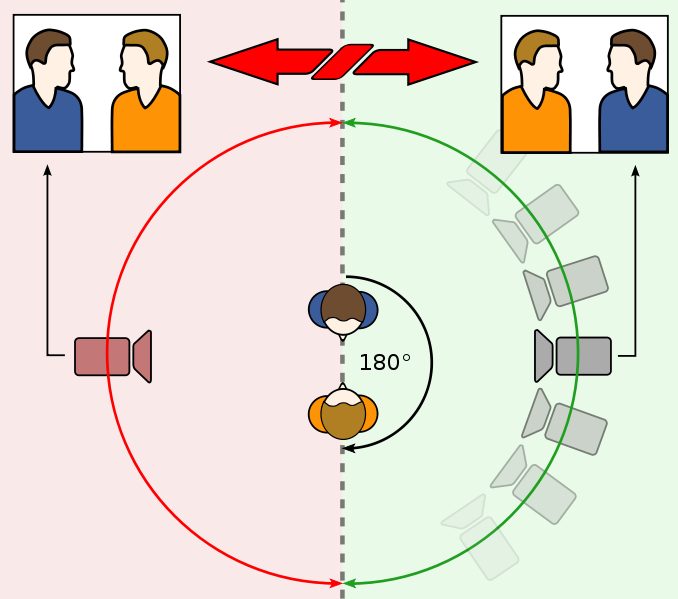
180 degree rule - The 180° rule is a basic guideline in film making that states that two characters (or other elements) in the same scene should always have the same left/right relationship to each other. If the camera passes over the imaginary axis connecting the two subjects, it is called crossing the line. The new shot, from the opposite side, is known as a reverse angle.
Example:

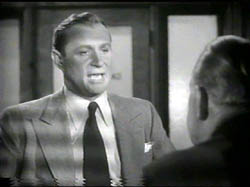
Shot reverse shot - Conventional technique of cinematography and editing for the filming of dialogue. In the classic shot/reverse shot sequence, the camera frames each speaker (usually 2-4) in medium close-up as he or she recites a line of dialogue. The shoulder or profile of the listener can often be seen, slightly out of focus on the edge of the frame, while the camera is focused on the face of the speaker.
Example:

Match on Action - A match on action, a technique used in film editing, is a cut that connects two different views of the same action at the same moment in the movement. By carefully matching the movement across the two shots, filmmakers make it seem that the motion continues uninterrupted. For a real match on action, the action should begin in the first shot and end in the second shot.
Example:
Example:
Shot reverse shot - Conventional technique of cinematography and editing for the filming of dialogue. In the classic shot/reverse shot sequence, the camera frames each speaker (usually 2-4) in medium close-up as he or she recites a line of dialogue. The shoulder or profile of the listener can often be seen, slightly out of focus on the edge of the frame, while the camera is focused on the face of the speaker.
Example:
Match on Action - A match on action, a technique used in film editing, is a cut that connects two different views of the same action at the same moment in the movement. By carefully matching the movement across the two shots, filmmakers make it seem that the motion continues uninterrupted. For a real match on action, the action should begin in the first shot and end in the second shot.
Example:
Monday, 2 November 2009
Alfred Hitchcock
 Alfred Hitcock
We first looked at the 13 techniques that Alfred Hithcock uses to create tension and suspense. These 13 techniques are:
- The mind of the audience
- Frame for emotion
- Camera is not a camera
- Dialogue means nothing
- Point of view editing
- Montage gives control
- Keep the story simple
- Characters must break cliche
- Use humour to add tension
- Two things hapening at once
- Suspense is information
- Surprise and twist
- Warning: May cause Macguffin
Examples In Vertigo
- When Scotty is following Madeline and she walks into the art gallery to look at the painting of Carlotta and it looks from Scotty’s point of view.
- When Judie has a flashback of what happened at the bell tower with Madeline’s husband and how they set it up to make it look like she jumped off of the top.
Examples in Psycho
- Near the end, in the scene where Lila turns the mother’s skeleton around and Norman as his mother comes into the cellar. It’s all from Lila’s point of view.
- The shower scene where Marianne gets stabbed repeatedly in the back by Norman (as his mother); this is a montage as it shows his hand and then her back as a montage.
Subscribe to:
Posts (Atom)